Examination, research, imaging, and treatment at Virginia Museum of Fine Arts. Supervisors: Meredith Watson and Josh Summer.
Treatment: local consolidation, aqueous cleaning, varnishing, inpainting, and frame treatment.
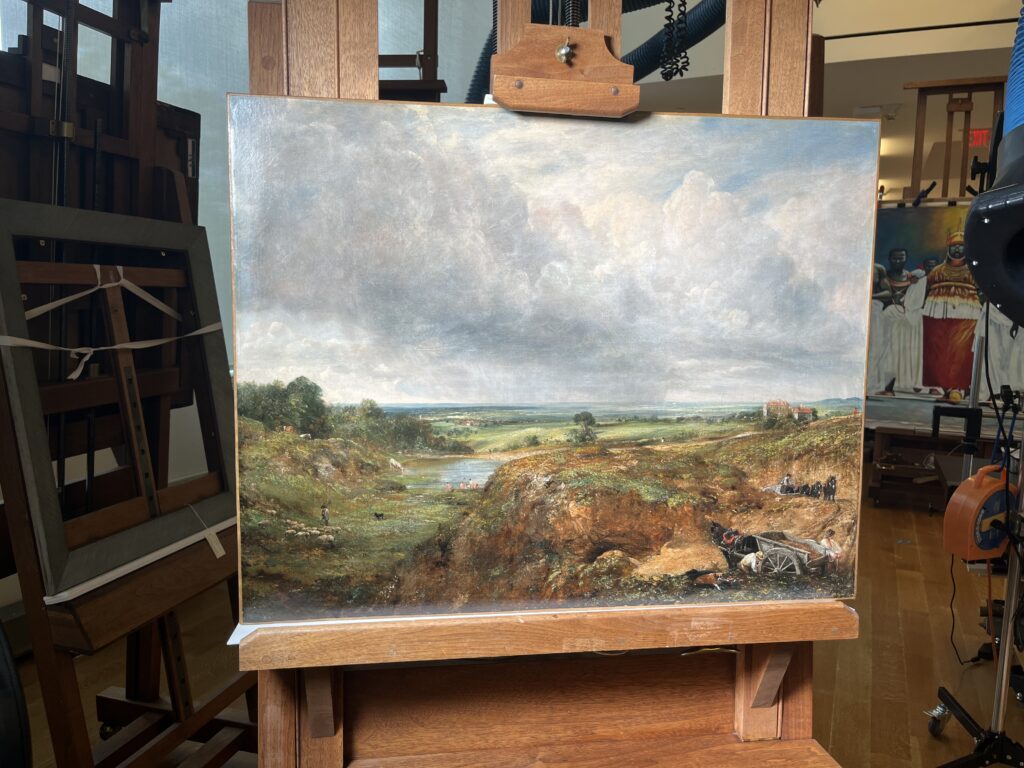
“Branch Hill Pond, Hampstead Heath”
John Constable
1824 – 1825
Oil on canvas
24 1/2 × 30 3/4 in
Before and after treatment slider


Normal illumination; auto-aligned with Photoshop.
Left: BT. Right: AT.
Condition and treatment report
Images
Progress photos


Left: Amy Trompeter. Right: Catherine Dussault.
Examination report appendices
To support my examination report, additional research was compiled in relation to the painting’s historical context, other depictions of Branch Hill Pond by Constable, a full timeline of the painting’s known treatments, displays, and provenance, and transcriptions of labels attached to the backing board.
Historical context
General description:
Described by Constable to the patron as “A scene on Hampstead Heath, broken foreground and sand carts, Windsor Castle in the extreme distance on the right of the shower. The fresh greens in the distance (which you are pleased to admire) are the fields about Harrow, and the villages of Hendon, Kilburn, &c.”[a]
Auxiliary support:
N/A
Primary support:
The size of the painting is similar to the standard English ‘three-quarters’ size (30 by 25 inches) which could have been cut from a narrow 27-inch-wide roll of canvas and still accommodate 1-inch-wide tacking margins on each side. [b]
Preparation layer(s):
Constable is known to have employed toned priming layers of different colors beneath his skies through the 1820s, ranging from blue to buff to salmon pink. These are described as forming “an integral part of the final image. It gives characteristic colour and tone to large areas of the composition, where it remains visible through sporadic brush and palette knife work in the paint layers.” [c]
Beginning the 19th of May 1824, Constable hired John Dunthorne Junior, the son of his friend and sketching partner John Dunthorne Senior, as a studio assistant. In correspondence, Constable describes that Dunthorne Jr. “is squaring and working hard for me,” and “forwards me a great deal in subordinate parts such as tracing, squaring &c &c.” [d] As this overlaps with when Branch Hill Pond was likely begun, it is possible that Dunthorne Jr. prepared the horizon line.
The lack of other specific underdrawing is related to the fact that Constable painted the Branch Hill Pond scene at least ten other times in his lifetime (see Appendix 2: Other depictions of Branch Hill Pond by Constable). He developed familiarity with the landscape through his oil sketches and preliminary drawings.
Evidence suggests that when Constable created larger versions of his sketches, he used a grid system to scale up. When he created duplicates of his finished pieces, a greater extent of underdrawing is associated with the copy. [e] This piece’s direct approach helps distinguish it as the first version, despite confusion related to the 1917 Christie’s sale alongside its duplicate, currently at the Oskar Reinhart Am Römerholz in Winterthur, Switzerland.
Paint layer(s):
Generally, Constable painted his landscapes from background to foreground, while simultaneously re-painting each layer wet-over-dry with increasing levels of detail.
In other Constable paintings from 1824 – 1826, researcher Sarah Cove has positively identified the following pigments: lead white, vermillion, red iron oxide, red lake, yellow lake, Naples yellow, Prussian blue, natural ultramarine, umber, charcoal black, patent yellow, ivory black, mars browns, burnt terre verte, mars yellow, and Antwerp blue. [e] His binding media are identified as linseed oil with walnut oil in lighter colors. Evidence from his extant palettes also indicates that Constable sometimes included additives like egg, beeswax, and pine resin. [f]
Surface coating(s):
This painting is known to have been exhibited at the 1825 Royal Academy before being sold to Frances Darby, so the presence of original varnish is unknown. Sarah Cove describes that
Constable was aware of the benefits of varnishing and its proper timing. It is unlikely that his paintings were varnished by the exhibition time due to his working habits. [g] There is no evidence that Constable varnished the picture before it was sent to Darby.
Constable is known to have disliked the 19th century aesthetic preference for darker-toned paintings, though at some points he reluctantly did so to please his audience; “I have grimed it down with slime & soot – as he is a connoisseur and of course prefers filth & dirt, to freshness and beauty.” [h]
Frame:
Documentation supports that Constable worked with leading following London framemakers. In sale negotiations with Darby, Constable belabors the cost of original framing, “the frames are rich and cost me about £20 each.” [i] He is also known to have sometimes repurposed frames from his unsold Academy pictures. [j]
CITATIONS:
- [a] John Constable, Patrons, Dealers, and Fellow Artists, vol. 10, ed. R. B. Beckett, John Constable’s Correspondence, IV (Suffolk Records Society, 1966), 97.
- [b] Jacob Simon, “‘Three-Quarters, Kit-Cats and Half-Lengths’: British Portrait Painters and Their Canvas Sizes, 1625-1850,” National Portrait Gallery, April 2013, https://www.npg.org.uk/collections/research/programmes/artists-their-materials-and-suppliers/three-quarters-kit-cats-and-half-lengths-british-portrait-painters-and-their-canvas-sizes-1625-1850/3.-further-standard-sizes.
- [c] Sarah Cove, ed., “Very Great Difficulty in Composition and Execution: The Materials and Techniques of Constable’s Sky and Cloud Studies of the 1820s,” in Constable’s Skies, by Frederic Bancroft (Salander-O’Reilly Galleries, 2004), 127.
- [d] John Constable, Patrons, Dealers, and Fellow Artists, vol. 10, ed. R. B. Beckett, John Constable’s Correspondence, IV (Suffolk Records Society, 1966), 159 – 161, 181.
- [e] Sarah Cove, “Constable’s Oil Painting Materials and Techniques,” in Constable (Tate Gallery Publications, 1991), 509.
- [f] Sarah Cove et al., “Mixing and Mingling: John Constable’s Oil Paint Mediums c. 1802-37, Including the Analysis of the ‘Manton’ Paint Box,” in Painting Techniques History, Materials and Studio Practice: Contributions to the Dublin Congress, 7-11 September 1998 (International Institute for Conservation of Historic and Artistic Works, 1998).
- [g] Sarah Cove, “Constable’s Oil Painting Materials and Techniques,” in Constable (Tate Gallery Publications, 1991), 515.
- [h] Ibid, 516.
- [i]John Constable, Patrons, Dealers, and Fellow Artists, vol. 10, ed. R. B. Beckett, John Constable’s Correspondence, IV (Suffolk Records Society, 1966), 97
- [j]Jacob Simon, “John Constable and Picture Frames,” The Frame Blog, February 1, 2026, https://theframeblog.com/2026/02/01/john-constable-and-picture-frames/.
Other depictions of Branch Hill Pond by Constable

Branch Hill Pond, Hampstead Heath. 19th cent. Oil on canvas, 11 7/8 x 16 1/16 inches. Philadelphia Museum of Art. https://www.philamuseum.org/objects/102692.

Branch Hill Pond, Hampstead. 1819. Oil on canvas, 10 x 11 13/16 inches. Victoria and Albert Museum. https://collections.vam.ac.uk/item/O84528/.

Branch Hill Pond, Hampstead Heath. 1824-1825. Oil on canvas, 24 1/2 x 30 3/4 inches. Virginia Museum of Fine Arts. https://www.vmfa.museum/artworks/branch-hill-pond-hampstead-heath-59421.

John Constable, Branch Hill Pond, Hampstead 1824/25. 1824-1825. Oil on canvas, 23 1/2 x 30 1/4 inches. Oskar Reinhart Am Römerholz. https://www.roemerholz.ch/en/john-constable-branch-hill-pond-hampstead-182425-3.

Branch Hill Pond, Hampstead Heath. After 1825. Oil on canvas, 23 x 29 1/2 inches. Philadelphia Museum of Art. https://www.philamuseum.org/objects/103818.

Branch Hill Pond, Hampstead Heath, with a Boy Sitting on a Bank. ca 1825. Oil on canvas, 22 13/16 x 29 7/16 inches. Tate Gallery. https://www.tate.org.uk/art/artworks/constable-branch-hill-pond-hampstead-heath-with-a-boy-sitting-on-a-bank-n01813.

Branch Hill Pond, Hampstead Heath, with a Cart and Carters. ca 1825. Oil on canvas, 21 x 30 1/4 inches. Tate Gallery. https://www.tate.org.uk/art/artworks/constable-branch-hill-pond-hampstead-heath-with-a-cart-and-carters-n04237.

Hampstead Heath. ca 1825. Oil on canvas, 18 x 15 1/2 inches. Yale Center for British Art. https://collections.britishart.yale.edu/catalog/tms:646.

Branch Hill Pond, Hampstead. 1828. Oil on canvas, 23 7/8 x 30 3/4 inches. Cleveland Museum of Art. https://www.clevelandart.org/art/1972.48.

Hampstead Heath, Branch Hill Pond. 1828. Oil on canvas, 23 7/16 x 30 9/16 inches. Victoria and Albert Museum. https://collections.vam.ac.uk/item/O69872/.

Hampstead Heath with a Rainbow. 1836. Oil on canvas, 20 x 30 inches. Tate Gallery. https://www.tate.org.uk/art/artworks/constable-hampstead-heath-with-a-rainbow-n01275.
Timeline
For the purposes of publication, names of individuals have been redacted.
Treatment summary:
1825 – 1949: unknown
- Glue-paste lining
- Overpainted
1952: National Gallery of Art
- X-ray exam: possible abrasion or overcleaning
- UV exam: overpaint
- Visual exam: no loss of paint film
- Treatment: “cleaned and waxed”
1982: VMFA
- Backing added
- Replaced two missing keys, secured all with wax
- Noted losses from rabbet and crack in clouds
2003: VMFA
- Aqueous cleaning with “ammonia water” pH 8.5 and saliva
- Retouch losses with watercolor
Full timeline:
| Date | Event | Location | Notes |
|---|---|---|---|
| 1825 | Exhibited | Royal Academy, London | No. 115 |
| 1825 | Purchased | London | |
| 1903 | Exhibited | Burlington Fine Arts Club | No. 54 or 58 |
| 1903-1908 | Purchased | London | |
| 3-May-17 | Purchased | Christies, London | Sold by the estate of Beecham to Christies |
| 1918 | Purchased | ||
| Unknown | Purchased | London | |
| Unknown | Purchased | St. Paul, Minnesota | |
| Unknown | Purchased | New York | |
| Unknown | Purchased | ||
| 1949 | Purchased | Was lined when acquired | |
| 1950 | Exhibited | “Paintings by Impressionists and Post-Impressionists,” VMFA | |
| 1950 | Storage | 205 | |
| Feb-52 | Analysis | National Gallery of Art | X-ray and condition report |
| Jul 10 – Aug 1952 | Treatment | “Cleaned and waxed” | |
| 1-Jul-53 | Storage | 206 | |
| 1-Oct-53 | Storage | 119 | |
| 11 Jul 1956 – 13 Jun 1962 | Display | English 18th century gallery, VMFA | |
| 3-Nov-63 | Exhibited | Artmobile II, circuit 3 | |
| Nov-63 | Display | Late English Gallery, VMFA | |
| 1965 – 1966 | Exhibited | Williams Collection Artmobile | |
| Jun-66 | Storage | American Storage | |
| 1966 – 1968 | Display | English Gallery | |
| Oct – Nov 1969 | Exhibited | “Masterpieces from Southern Museums,” Norfolk Museum | |
| Dec 1969 – Jun 1972 | Display | English Gallery | |
| Sep 1973 – Jan 1974 | Exhibited | “John Constable, The Natural Painter,” Aukland, Melbourne, and Sydney | |
| Mar-74 | Display | English Gallery | |
| Jan-75 | Exhibited | Landscape Artmobile | |
| 18 Feb – 25 Apr 1976 | Condition Report | ||
| Jun-76 | Exhibited | “Constable: Paintings, Watercolours and Drawings,” the Tate Gallery, London | Cat. No. 239 |
| Jul 1976 – Jun 1978 | Display | English Gallery | |
| Jan-79 | Display | English Decorative Arts Gallery | |
| Feb-81 | Storage | N.G. I | |
| Aug-81 | Display | East Alcove | |
| Oct-81 | Storage | P.S. Rack 2 | |
| Feb 1982 – Jul 12 1984 | Display | English Gallery | |
| 2-Jun-82 | Treatment | Replaced keys, anchored with wax, black plastic stripping, and backing | |
| 13-Jan-83 | Condition Report | Excellent, small losses from abrasion | |
| 9-Feb-83 | Condition Report | Faint stretcher impression, slight crackle in clouds, rabbet abrasion, damage at frame joints | |
| Apr – Sep 1983 | Exhibited | “Constable’s England,” the Metropolitan Museum of Art, New York | |
| 7 Jun – 7 Jul 1985 | Exhibited | “British Painting,” the Danville Museum of Fine Arts and History | |
| 9-Jul-85 | Display | English Gallery | |
| 30 Jan – 17 Jun 1986 | Exhibited | “John Constable,” Isetan Museum of Art, Tokyo, Fukuoka Prefectural Museum, Yamanashi Prefectural Museum of Art, Kofu, Sogo Museum of Art, Japan | |
| 1986 | Condition Report | ||
| 24-Jul-86 | Storage | P.S. Rack 21 | |
| 24-Jul-86 | Condition Report | Needs surface cleaning | |
| 17-Oct-86 | Storage | P.S. Rack 23 | |
| 29-Jul-87 | Display | English Gallery | |
| 21-Oct-87 | Exhibited | “Egypt” | ? |
| 30-Mar-88 | Condition Report | Surface good | |
| 9 May – 25 Jun 1988 | Exhibited | “John Constable, R.A. (1776-1837)” Salander-O’Reilly Galleries, Inc., New York City | |
| 1-Aug-88 | Condition Report | Fine condition | |
| 23-Aug-88 | Display | English Gallery G407 | |
| 7-Jan-91 | Condition Report | Frame chipped, miters separating, small loss at upper left corner, crack in sky appears stable, abrasion on left, edge, vertical cracking at horizon | |
| 27 Jan – 29 Apr 1991 | Exhibited | “The Rise of Landscape Painting in France: Corot to Monet,” the Currier Gallery of Art, Manchester, NH | |
| 13 Jun – 15 Sep 1991 | Exhibited | “John Constable 1991.” The Tate Gallery | |
| 1992 | Storage | SP, grey table, rack 61, RK 50 | |
| 3 Nov 1991 – 29 Mar 1992 | Exhibited | “The Rise of Landscape Painting in France: Corot to Monet,” Dallas Museum of Art, High Museum of Art | |
| 15-Apr-92 | Condition Report | No change | |
| 29 Apr – 18 Jul 1993 | Exhibited | “Perspectives on Romanticism,” VMFA G428 | |
| 1995 | Display | G409A | |
| 1995 | Storage | SP fixed rack on left, SW table | |
| 1996 | Storage | SCL conservation lab | |
| 19-Nov-99 | Storage | SP table, rack 64 | |
| 2001 | Condition Report | Liner created, frame treatment, backing, and glazing | |
| 2002 | Exhibited | “Bartolomé Esteban Murillo, 1617–1682: Paintings from American Collections,” Kimbell Art Museum, Forth Worth, Los Angeles County Museum of Art | |
| Jan-03 | Treatment | Cleaned with ‘ammonia water’ (pH 8.5) and saliva, retouched previous cleaning spot and losses with watercolor | |
| 2003 – 2004 | Condition Report | No major change | |
| 30 Jan 2003 – 4 Jan 2004 | Exhibited | “Romantic Painting in England and France, c.1820-c.1840,” Tate Britain, Minneapolis Museum of Arts, Metropolitan Museum of Art | |
| 18-May-05 | Treatment | Brief frame treatment | |
| 2011 – 2012 | Exhibited | “VMFA 75th Anniversay Statewide Exhibition, From Goya to Van Gogh.” Peninsula Fine Arts Center, Norfolk, William King Regional Art Center, Abingdon, Museum of the Shenandoah Valley, Winchester, Daura Gallery, Lynchburg College, Lynchburg, Radford University, Radford |
Labels
Frame:
Tag attached to left d-ring: “49.18.4”
Top left label: “28| Hampstead Heath| Oil on canvas| Lent by the Virginia Museum of Fi[ne Art]s, Richmond, USA”
Top right label: “SL 83. 33”
Left center label: “No. c/12 54” and “7951”
Right, upside down inscription in chalk “13” (2x)
Slip frame, left center, inscription in pencil “front”
Bottom left stamp in black, “716”(?)
Backing board:
“COMMONWEATH of VIRGINIA| Virginia Museum of Fine Arts| 2800 GROVE AVENUE/RICHMOND, VIRGINIA 23221-2466| John Constable| Branch Hill Pond, Hampstead Heath, 1824-25|oil on canvas| Virginia Museum of Fine Arts, Richmond| The Adolph D and Wilkins C. Collection 49.18.4”
“Constable to Delacroix| 5 Feb – 11 May 2003| Tate Britain| CONSTABLE, John 1776 – 1837| Branch Hill Pond, Hampstead Heath| 1825| X01722| 114| Oil on canvas| 62.2 x 78.1 cm| Virginia Museum of Fine Arts (Richmond, USA)”
“The Metropolitan Museum of Art| Crossing the Channel: British and French Painting in the Age| of Romanticism (10/7/2003 to 1/4/2004)| Virginia Museum of Fine Arts| John Constable| Branch Hill Pond, Hampstead Heath| SL.20.2003.57.2 Cat No.: 114”
“AMIRAN ABRASION SENSITIVE COATED GLASS| SHATTER PROOF| DO NOT TAPE GLASS| DO NOT TOUCH GLASS| DO NOT CLEAN GLASS| HANDLE ART OBJECT WITH GLOVES ONLY”
Detached, found in curatorial file: “The Tate Gallery| LENDER: [blank]| ADDRESS: [blank]| ARTIST: John Constable| TITLE: Landscape (Branch Hill| Pond, Hampstead) |EXHIBITION: JohnConstable [sic]| DATES: Feb. 18 – April 25| CAT NO 239”
Acknowledgements
Special thanks to Meredith Watson, Josh Summer, Catherine Dussault, Caroline Rawls, and Amy Trompeter for helping my treatment along the way, and being excellent mentors during my summer internship.